
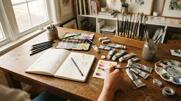
Every portrait and caricature you order from Photolamus is drawn by a real person — not a filter, not an algorithm. And that's true whether we're turning your photo into a portrait from our studio or sketching a room full of guests live at a wedding or corporate party. We talk a lot about our artists' skill and style, but almost never about what's actually in their hands while they work. So we handed three of our artists a two-week supply of Artsmile gear, asked them to use it on real jobs, and told them to be brutally honest. No script, no talking points. Here's what came back.
Why Artsmile, specifically
Artsmile isn't some random brand we picked off a shelf. It grew out of the same creative roots as Photolamus, and it's built in partnership with SmileyWorld® — yes, the original Smiley company, the one behind the smiley face that's been part of everyday visual language for decades. The idea behind the products is simple: art supplies that make creating feel easy, from the first pencil line to a finished piece on canvas.
For our team, this wasn't really a "product review." It was more of an internal gut check. Photolamus artists work in two very different modes: some do quiet, detailed portrait work from a photo, others are out drawing caricatures on the spot at live events, where there's no do-over and no time to fuss with tools. We wanted to know if Artsmile could hold up in both worlds.
Three artists, three completely different jobs
To keep this from turning into one person's opinion, we picked artists with very different day-to-day work: one does fine graphite portrait work, one paints in watercolor and acrylic, and one does fast, live caricatures at events — weddings, corporate parties, birthdays, the whole range.
| Artist | What they do at Photolamus | What they tested |
|---|---|---|
| Maria | Graphite and pencil portraits (studio work, from photos) | Graphite pencils, colour pencils, sketchbook |
| Andrew | Watercolor and acrylic portraits (studio work) | Watercolors, acrylics, brushes, canvases |
| Olivia | Live caricatures at events | Brushes, colour pencils, sketch paper |
Maria: "A pencil either lies to you or backs you up"
Maria's portraits live and die on line work and shading — there's no color to cover up an uneven tone. So her standards for graphite pencils are borderline technical: consistent hardness, clean sharpening, no grit dragging on the paper.
She worked with the Artsmile & SmileyWorld® Graphite Pencils, Set of 12 (around $16) for two weeks straight.
"I'm honestly skeptical of 'do everything' sets — usually two or three pencils are actually good and the rest are filler. This set made sense across the whole range: hard grades for light construction lines, soft grades that give you real, velvety black without pressing hard. Nothing crumbled when I sharpened it, which for me is half the battle with any pencil," Maria says.
She also ran the Artsmile & SmileyWorld® Colour Pencils , available in a 12-piece set (around $16) and a 24-piece set (around $29), through their paces for quick color studies she does before a final graphite portrait — where the pigment needs to lay down fully saturated on the first pass, not fade out into a chalky streak.
"I grabbed the 24-piece set — for me that's the sweet spot between price and having enough skin-tone and hair-tone variety, which I need constantly for portraits. They blend smoothly and don't shed on the page," Maria adds.
What Maria's keeping in her regular kit
- The 12-pencil graphite set, as her main go-to for sketching and final shading.
- The 24-piece colour pencil set, for color studies and light touch-ups on finished graphite portraits.
- Her takeaway: nothing here forced her to change her grip or pressure to get good results — it just slotted into how she already works.
Andrew: "A brush needs to hold its shape, not my patience"
Andrew paints portraits in watercolor and acrylic — two mediums that punish a bad tool fast. A cheap brush loses its point three strokes in, a bad canvas fights the paint, and cheap paper warps the second water touches it. He got the full lineup: three brush shapes, watercolor, acrylic, and canvases in a few sizes.
"I started with the Filbert brush set — 13 brushes in different sizes, around $23. Filbert is my most-used shape because it does both a wide fill and a controlled edge. The synthetic bristles held their shape through an entire session, even with a lot of water and heavy wringing out. No splaying, no stray hairs," Andrew says.
For comparison, he also tried the Flat Shape set and the 12-piece Mixed Shapes set, and ended up with a pretty simple system for picking between them.
| Artsmile brush set | Count | Price | Best for |
|---|---|---|---|
| Filbert Shape | 13 pcs | ~$23 | Portraits, smooth tonal transitions, skin |
| Flat Shape | 13 pcs | ~$23 | Backgrounds, large fills, clothing with hard edges |
| Round Shape | 13 pcs | ~$23 | Fine detail: eyes, eyebrows, thin lines |
| Mixed Shapes | 12 pcs | ~$19 | A solid all-around starter set if you're still figuring out your style |
On the paint side, Andrew ran parallel tests with watercolor and acrylic, both available in a 12-tube set (around $21) and a 24-tube set (around $35), at 12 ml per tube.
"The 24-color watercolor set surprised me with how much pigment it holds — you cut it with water and it doesn't just wash out to gray the way cheaper sets do. The acrylic covers a previous layer in one pass too, which actually saves real time in a session — and time is basically what a client is paying for," Andrew notes.
He tested canvases in two formats — a 12x16" rectangle (set of 3, around $28) and a 12"-diameter round canvas (set of 3, around $19) — and paid close attention to something people rarely notice until their first brushstroke: how tight the canvas is stretched and how well it's primed.
"100% cotton, triple-primed with gesso — the paint doesn't sink into the weave or pool at the edges. I almost never reach for round canvases, but it worked surprisingly well for a head-and-shoulders portrait. Less dead space on the sides, and the composition kind of centers itself," Andrew says.
Olivia: "At an event, you've got about twenty seconds for your tools to not let you down"
Live caricature work is about as far from a quiet studio as it gets. There's noise, a tight time limit, and a guest standing there a little nervous about seeing an exaggerated version of themselves in two minutes flat. The tools have to perform instantly, no warm-up.
"I need a brush that doesn't fall apart if I'm rushing, and a pencil that gives me full saturation right away instead of ten extra passes. I grabbed the Mixed Shapes brush set — 12 pieces, different shapes, around $19 — so I can jump from a wide stroke for the background to a fine line for facial expressions without digging through my kit for 'the right one,'" Olivia says.
For colour pencils, she picked the compact 12-piece set (around $16) specifically for events — where the weight of her bag matters more than having every possible shade on hand.
"24 colors is great in the studio, but at an event I'm realistically using maybe 8 to 10 shades for skin and clothing. The 12-piece set is exactly enough, and it's noticeably lighter in a bag full of other supplies," Olivia adds.
She also tested paper from the Pads & Sketchbooks line — heavyweight, cold-pressed paper meant to handle both dry media and light watercolor washes.
"The paper doesn't fuzz up under fast, hard lines — and at events, every line is fast. That was really my main test: if the paper can take pencil pressure without pilling, I'm sold," Olivia says.
The full rundown: what got tested, and the verdict
| Category | Product | Price | Tested by | Verdict |
|---|---|---|---|---|
| Graphite pencils | Set of 12 | ~$16 | Maria | Keeping it in regular rotation |
| Colour pencils | Sets of 12 and 24 | ~$16 / ~$29 | Maria, Olivia | 12-pc for events, 24-pc for studio work |
| Brushes | Filbert, Flat, Round, Mixed | ~$19–$23 | Andrew, Olivia | Filbert is the portrait favorite; Mixed is the speed favorite |
| Watercolor / acrylic | Sets of 12 and 24 x 12ml | ~$21 / ~$35 | Andrew | Strong pigment load, good one-pass coverage |
| Canvases | Rectangular and round, multiple sizes | ~$19–$38 | Andrew | Round format was a genuine surprise for portrait work |
| Sketch paper | Heavyweight, cold-pressed | — | Olivia | Holds up to fast, heavy-handed strokes |
Prices are approximate USD conversions from Artsmile's listed EUR pricing and are rounded for readability — check artsmile.art for exact, current pricing at checkout.
What actually separates good art supplies from the rest
While we were pulling this feedback together, our artists landed on the same short checklist without even comparing notes — the things they look for in any art supplies, regardless of brand. Worth sharing if you're shopping for your first real set.
- Consistency across the whole set. One great pencil in a 12-pack doesn't make it a great set. Every piece should behave predictably.
- How it holds up under pressure. A brush under heavy water use, a pencil under a hard press, paper under fast strokes — that's where you actually see the difference between a good tool and a nice-looking box.
- Matching the tool to the job, not just the price tag. A 24-color set is wasted if it's living in an event bag — a lighter, 12-color set is more practical there, full stop.
- Non-toxic, safe materials — especially relevant if there are kids in the house who also like to draw, not just the working artist.
If you want to try it yourself
We're not going to pretend two weeks and three artists is the final word on these supplies — it's an honest, if limited, take. But when the people who draw strangers' faces for a living, every single day, in a studio and on the spot at real events, choose to keep these tools in their kit — that's about as real a recommendation as we can give without any spin.
You can check out the full lineup — brushes, pencils, paints, canvases, sketchbooks — at artsmile.art . And if you'd rather see what our artists create with them (and a few other tools too), that's what we do every day at Photolamus — whether it's a portrait from your favorite photo or a live caricature artist at your next event.